Someone wrote that quote.
Someone wrote that lease.
They knew what they were doing.
Most of us don't. We sign anyway. Pay anyway. Because the alternative is reading every line like a contract lawyer and googling every line item like a mechanic, and nobody has that kind of time.
So we built the thing we wished we had the last time we stood in a driveway staring at a fourteen-hundred-dollar repair estimate. Point your camera at a document. quote, bill, lease, contract, NDA, medical statement, whatever. Overquoted reads every line, flags what's overpriced, and translates the legalese. In about fifteen seconds.
No, it's not a lawyer. No, it doesn't replace a real negotiation. But it'll tell you whether the plumber's "after-hours premium" is real, what "binding arbitration" means for you specifically, and which three line items on your vet bill don't match what they actually did.
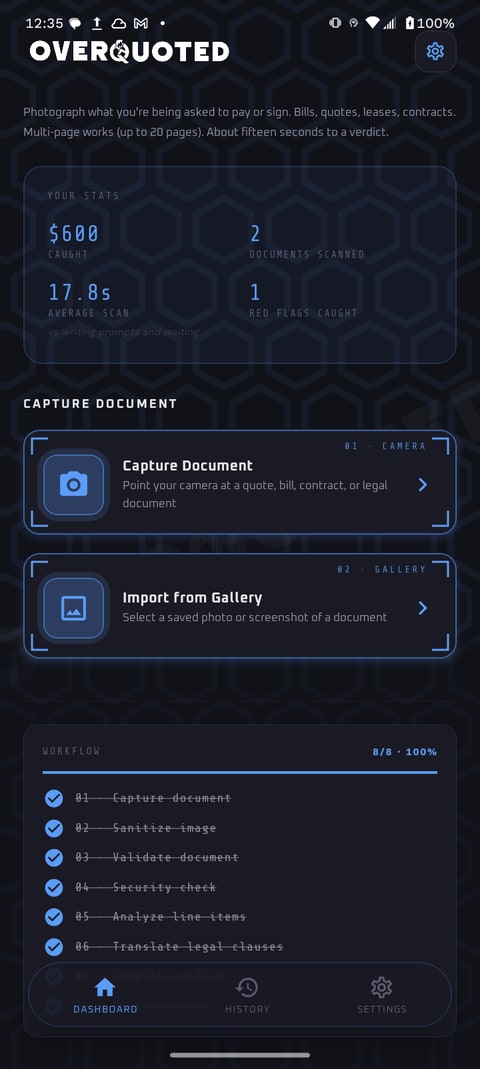
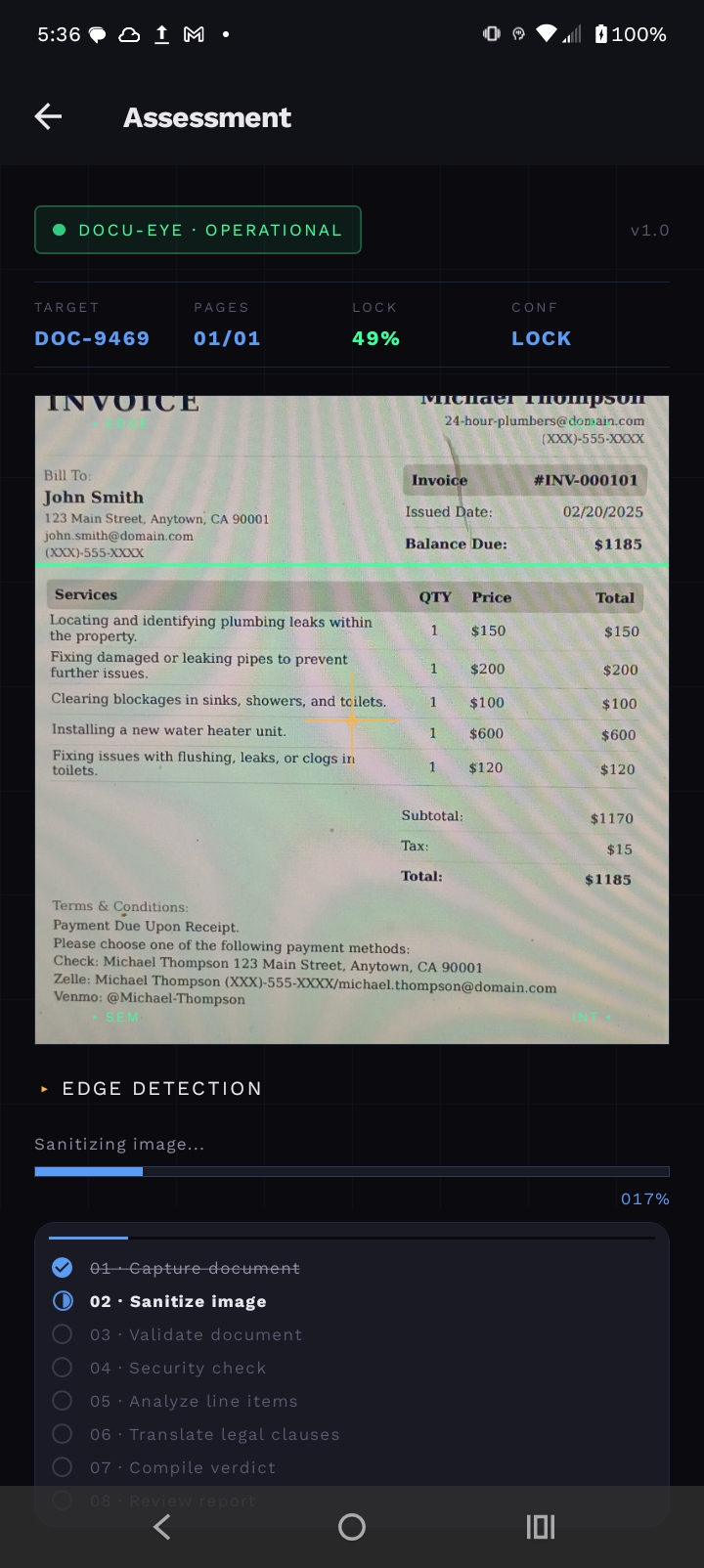
From photo to verdict, in about fifteen seconds.
Four screens. No signup-wall. No "book a demo."


Here's an invoice we ran through the app. See if you'd catch what it catches before you scroll to the verdict.
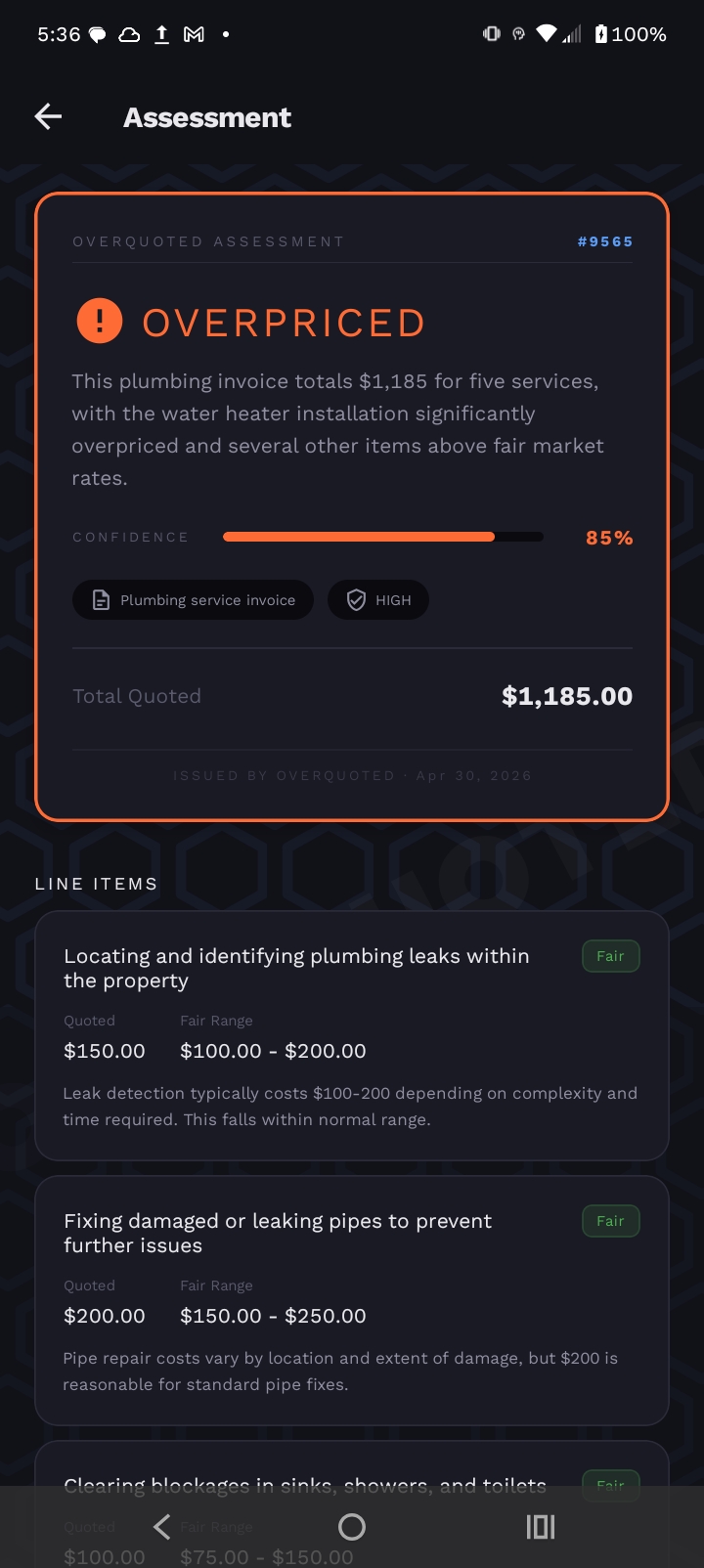
This invoice is $347 above the fair range. Two line items don't match what the document says happened.
-
SUSPICIOUS
After-hours premium$210Invoice timestamp: 10:47 AM. That's not after-hours. The charge contradicts the document it's printed on.
-
HIGH
Garbage disposal$480Fair range: $280–$380. The unit retails for $90–$150 at any hardware store; install is about an hour.
-
HIGH
Labor 3 hrs @ $165/hr$495Top of the market. Typical residential plumbing labor runs $95–$135/hr in most US metros.
-
FAIR
Service call$89Within the typical $75–$125 range.
Two of the six line items are bad. One is the kind of bad you'd only catch if you went back and read the timestamp on the invoice. That's the job.
Contracts use specific words for specific reasons. Here's one most people sign without reading.
"Tenant hereby waives any and all rights to a jury trial for any matter arising hereunder and consents to binding arbitration with the American Arbitration Association, with fees to be split equally between the parties."
If something goes wrong, you can't sue in court with a jury. You'd have to use private arbitration. a paid service. and split the costs 50/50 with your landlord.
Arbitration filing fees run $1,000–$5,000, often more than the damages you'd be seeking. Clauses like this are designed to make disputes too expensive to pursue at all. If you're about to sign, it's worth asking whether this can be struck. a surprising number of landlords agree if pushed.
This clause is in roughly 70% of residential leases I've read. It gets signed and forgotten. Then somebody has a real dispute with their landlord, and finds out what they actually agreed to.
A FAIR QUESTION
"I have a chatbot. Why not just use that?"
You can. A chatbot will read a contract if you upload a photo, write a careful prompt, and wait. We are not pretending it can't.
THE CHATBOT WAY
- Open the chatbot app
- Tap upload, find the photo
- Type a prompt that makes sense
- Wait while it generates prose
- Read three paragraphs and try to extract the actual answer
- Ask follow-ups when it's vague
- Decide
- Tap analyze
- Wait fifteen seconds
- Read the verdict card
- Push back at the counter
Verdict pill. Confidence score. Fair-range table. Severity-rated clauses. The exact sentence to say. Nothing to extract from paragraphs.
Documents stay in server memory and are discarded the moment the verdict comes back. We do not write them to disk. We do not retain them. You do not have to read a settings page to find out whether your medical bill is becoming training data. And $24.99 a year is less than two months of a chatbot subscription.
Overquoted is industry-agnostic. We've run it on auto shop bills, residential leases, gym contracts, freelance retainers, NDAs, medical statements, cell-carrier upgrades, a storage-unit agreement that tried to hold the customer liable for damage caused by the facility's own security camera, and a three-page "estimate" from a tree removal company that somehow included a $400 charge for "site assessment." If a document has a dollar sign on it or a signature line at the bottom, it's probably fair game.
Point your camera at the document. up to twenty pages per scan. Wait about fifteen seconds. You get a verdict, every line rated FAIR / HIGH / SUSPICIOUS, every clause translated into plain English with a severity rating, and. when there's room to push back. a concrete suggestion for what to negotiate first.
Your documents never touch our disk.
We're a consumer-advocate tool, not a data broker. The document goes in, the verdict comes out, nothing's left on our side when it's done.
- We don't sell your data. We don't have "insights partners." There isn't a version of us that does, and there won't be.
- Your document is analyzed in server memory and discarded the moment the verdict comes back. Nothing hits our disk.
- Metadata is stripped on arrival. EXIF, GPS, device ID. Whatever your camera stamped on the photo is gone before analysis.
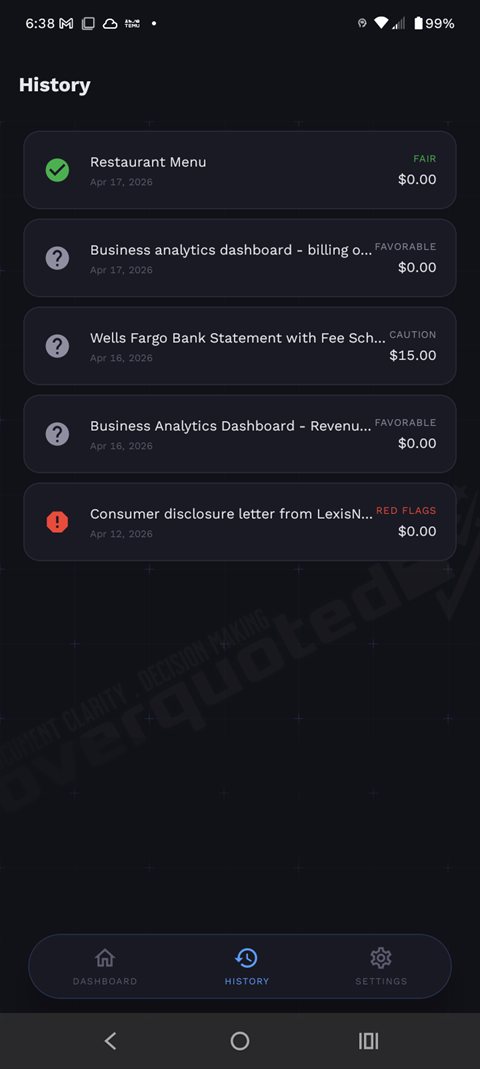
- Your scan history lives on your device. Delete the app and it goes with it.
- We make money by charging you a subscription. That's the whole business model. If it ever changes, you'll hear it from us first.
Two free previews on the house. Run any quote, bill, lease, or contract through the app. you see the verdict on your own document. To unlock the actionable detail. line-item breakdowns, red flags, legal translations, negotiation scripts. it's $24.99 a year. Cancel anytime from Settings. no email, no "are you sure?" dialog, just gone.
- Free preview on every scan
- Full report unlocks with subscription
- Past previews unlock too
- Up to 20 pages per document
- Line-by-line price assessment
- Legal clause translation
- Red flag detection
- Negotiation suggestions
Honest questions, honest answers.
How accurate is it, really?
Depends on the document. On commodity line items. common parts, typical labor rates, standard service fees. it's very consistent, because there's real market data behind the fair-range calls. On specialty work or unusual regions, it's still useful, but that's why every verdict shows a confidence score. When the number is low, treat the output as a prompt for your own questions, not a final answer.
Is this legal advice?
No. Anyone selling you an app as "legal advice" should be reported to their state bar. Overquoted is informational. it flags clauses and rewrites them in language you can actually parse. For a real contract negotiation, a real dispute, or anything a lawyer would bill for, pay a lawyer.
What actually happens to my documents?
The image is analyzed in server memory and discarded the moment the verdict comes back. Nothing is written to any disk or database on our side. The structured verdict is returned to your device, which is also where your scan history lives. Delete the app and it's gone.
The full mechanism is in the privacy policy. Read it. not just the headline.
Can I cancel anytime?
Yes. From Settings inside the app, or through Google Play. You keep access through the end of the billing period you already paid for. No "contact support to cancel" runaround, no three-click dark pattern to find the button.
What documents does it actually handle?
Anything you can photograph and that has prices or signatures on it. Quotes, invoices, bills, leases, contracts, NDAs, service agreements, terms of service, medical statements, subscription agreements. Up to twenty pages at a time, analyzed as one document.
Refunds?
Case by case, genuinely. If the app didn't work for you, or something went wrong with a charge, hit the contact form. a real person reads it. and we'll sort it out.
Who's behind this?
Technium Foundry LLC. a small shop building consumer-advocate tools. Overquoted is one of them. Same people answer the support email, review refund requests, and ship the code. If something breaks, we hear about it directly.
Where our thinking comes from
I did not invent what a bad contract looks like. The patterns Overquoted flags come from decades of work by people who actually fight this stuff for a living. When we wrote the detection rules, we leaned on their publications.
- Consumer Reports Advocacy on junk fees, surveillance pricing, and the Junk Fee Prevention Act. advocacy.consumerreports.org.
- National Association of Consumer Advocates and the NACA Litigation Project on unfair consumer contracts. consumeradvocates.org.
These are citations, not endorsements. Neither organization has reviewed, endorsed, or partnered with Overquoted. We stand on their public work; they owe us nothing and we imply nothing.